
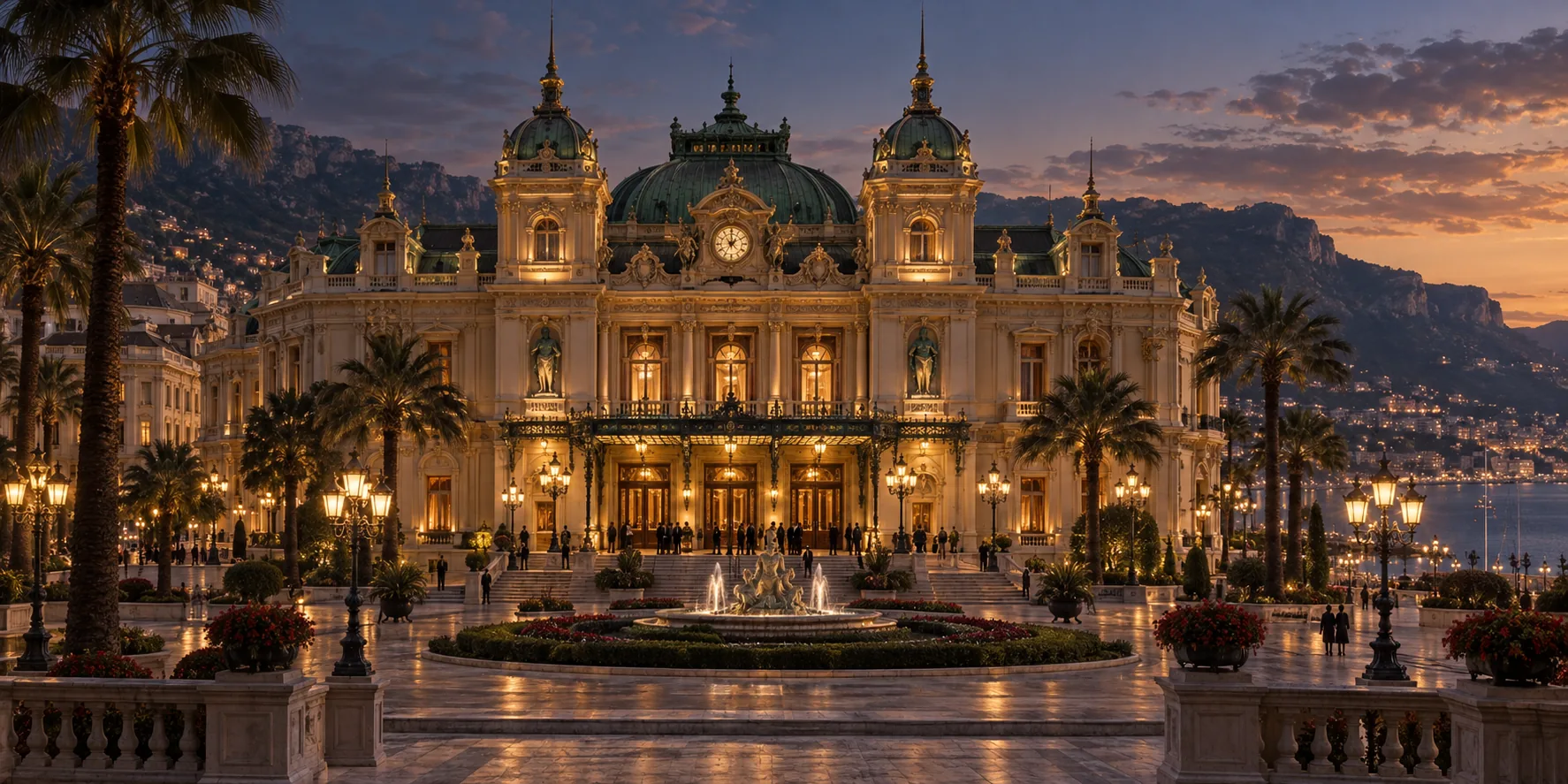
A famous casino is more than a room of games. It is a statement about its city, its patrons and the kind of evening it promises. The best-known properties changed expectations for architecture, entertainment and service.
Venice: the institution outlives its rooms
Casinò di Venezia claims a lineage beginning in 1638. Its current historic setting at Ca’ Vendramin Calergi, a Renaissance palace on the Grand Canal, belongs to a later chapter. This continuity across different premises makes Venice a useful reminder that “the casino” may refer to an institution, a location or a tradition—and those are not interchangeable.
The palace setting gives today’s visitor an image of aristocratic gaming. The original public Ridotto belonged to another context and building. Reading those layers separately makes the history more accurate.
Monte-Carlo: the resort as a composition
The Casino de Monte-Carlo opened in 1863 within a broader development led by Société des Bains de Mer. Hotel, café, square and gaming room formed one social landscape. This was a decisive step toward the casino as an organized travel experience, where architectural spectacle made entry feel like an event.
Its influence is not a single copied floor plan. Later destinations borrowed the idea that hospitality and entertainment could reinforce the attraction of the gaming house.
The Sands: performance becomes identity
The Sands opened on the Las Vegas Strip in 1952. UNLV’s archives document its association with the Rat Pack and the famous 1960 performances connected to Ocean’s 11. Its intimate showroom, publicity and hotel business helped make the casino resort a stage for celebrity culture. The property was demolished in 1996, but its entertainment model remained influential.
The Sands also shows how rapidly a landmark can become obsolete. Later towers and convention facilities expanded its scale, yet a new generation of resorts eventually overtook it.
Bellagio: theatre at urban scale
Bellagio opened on 15 October 1998 on the former Dunes site, according to MGM Resorts. It presented a different kind of spectacle: a highly coordinated setting of lake, fountains, galleries, restaurants and lavish interior spaces. The arrival experience was part of the design, not merely the route to a gaming floor.
The transition from Dunes to Bellagio illustrates a wider shift in Las Vegas toward large capital projects with multiple attractions. A landmark now had to occupy the imagination of visitors who might never enter a gaming room.
Marina Bay Sands: the integrated resort
Marina Bay Sands opened in Singapore in 2010. Its silhouette, conference facilities, retail, dining and cultural programming illustrate the integrated-resort model at metropolitan scale. Gaming is only one component of a complex destination. The building itself became a visual emblem of the city.
These landmarks span very different legal systems and social histories. They belong together because each widened the definition of what a casino destination could contain.
Sources & further reading
Selected institutional and primary sources used to verify key dates and context. External pages may change after publication.