
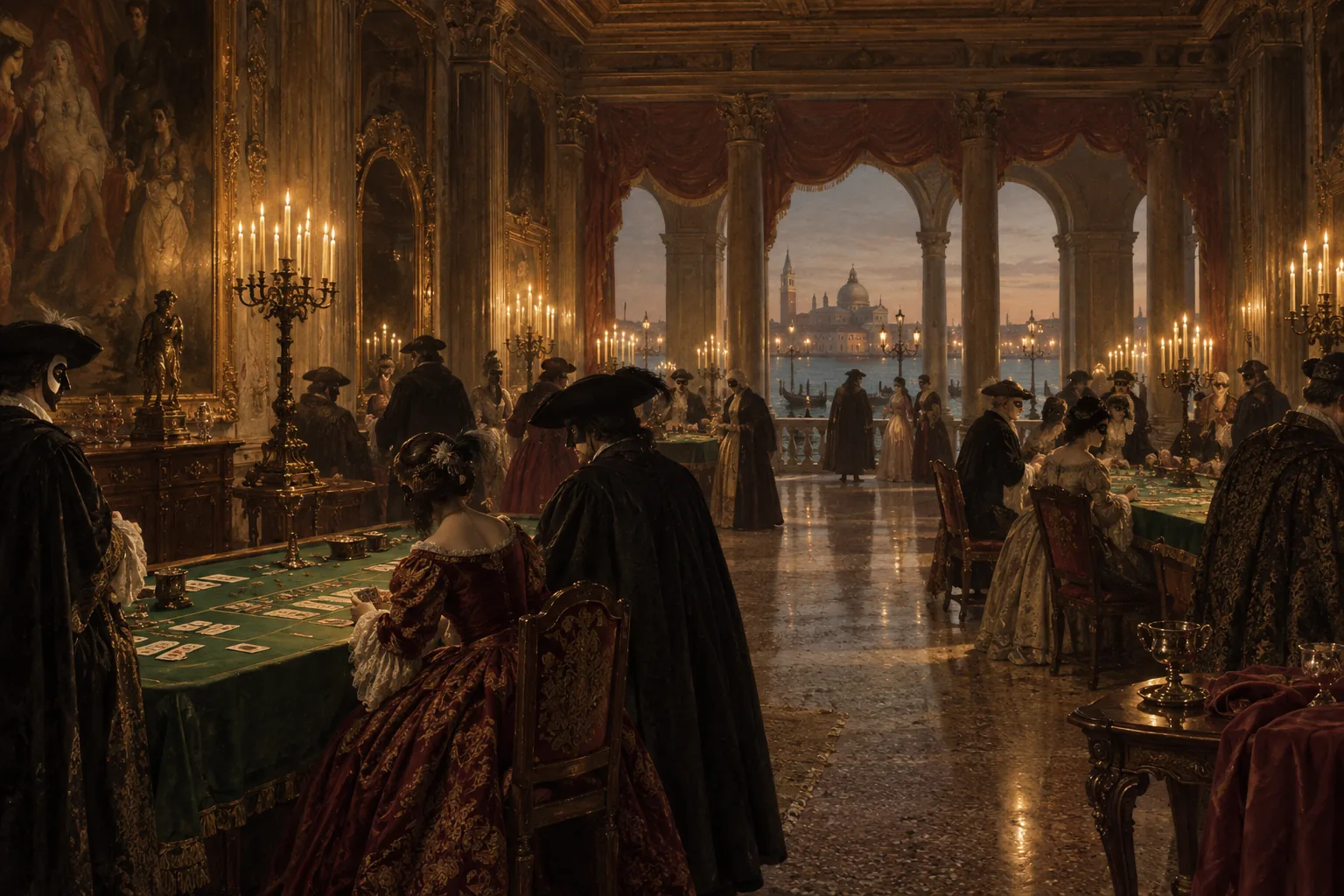
The casino was not born as a single building type. It emerged where social ritual, commercial entertainment and public oversight met. Early gaming spaces could be temporary, private or attached to theatres; the move toward a recognizable public house was gradual.
Before the casino had a name
Games of chance long predate purpose-built casinos. Cards, dice and wagering appeared in homes, inns and fairs across Europe. The places that hosted them differed in admission, social standing and official tolerance. A noble salon might treat play as one part of an evening of conversation; a public room needed more explicit rules about entry, conduct and money.
The word “casino” itself originally referred to a small house or social venue, rather than only to gambling. Applying today’s definition to every older venue can flatten important distinctions. Historians therefore look for the combination of a dedicated place, recurrent gaming, a host or operator, and some degree of oversight.
Venice and the Ridotto
Venice provides the most famous early example. Casinò di Venezia traces its institutional origin to 1638. The Republic’s Ridotto, associated with the Carnival season, made play more visible and controllable than scattered private rooms. Admission conventions and dress helped define who belonged in the room, while officials had an interest in supervising conduct.
The original Ridotto should not be confused with the present Ca’ Vendramin Calergi premises. The modern institution moved to the Grand Canal palace in the twentieth century. The distinction matters: an institution can preserve a long lineage while its buildings, operators and social purpose change substantially.
From courtly pastime to commercial destination
Across the eighteenth and nineteenth centuries, European spa towns and resorts developed gaming as one part of a wider visitor economy. Travel, accommodation, concerts and dining could surround the gaming room. The house became a destination rather than simply a place to sit at a table.
Monte-Carlo is a defining nineteenth-century case. Société des Bains de Mer links the creation of its resort and casino to 1863. The surrounding hotels and cafés made the casino part of an orchestrated district. Architecture, staff and formal service all conveyed social status. This model influenced later casino resorts, although the laws and audiences differed by place.
What the first houses established
The early houses established practices that still shape the industry: a controlled entrance, published or customary rules, designated staff, separation of public rooms from accounting areas, and an atmosphere deliberately designed around the visitor. Their history also shows that gambling rules were never only about the game. Governments and operators have repeatedly negotiated questions of taxation, public order, reputation and harm.
Calling one site the absolute “first casino” is less useful than asking what kind of venue it was. The Venetian lineage is unusually early and well known; later European houses transformed the concept into a complete tourism and hospitality system.
Sources & further reading
Selected institutional and primary sources used to verify key dates and context. External pages may change after publication.